Géosciences Montpellier
Université de Montpellier
Campus triolet cc060
Place eugène bataillon
34095 montpellier cedex05
FRANCE
Where to find us


Géosciences Montpellier manages a range of borehole geophysical tools used to characterize geological formations and fluids in situ. Borehole geophysical methods largely originate from the oil exploration industry, following their invention by the Schlumberger brothers in 1927 in Alsace, with techniques initially developed by the Schlumberger company.
Several types of measurements exist: borehole wall imaging, physical properties of the formation, physico-chemical properties of the fluid present in the well, as well as the distribution of fluids within the pore space.
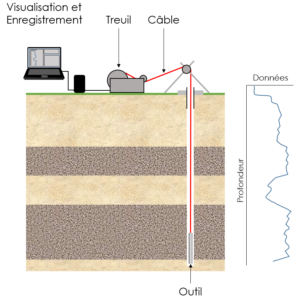
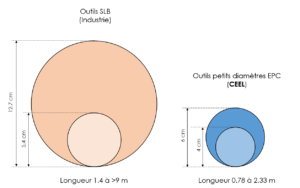
With the miniaturization of electronic equipment, and particularly the development of high-performance telemetry tools over the past 25 years, the technological leap achieved in “small-diameter” or “slimline” borehole instrumentation (4–6 cm, used at shallow to moderate depths, 0–2000 m) offers significant opportunities for both scientific and industrial applications in this field.
The slimline borehole geophysics and hydrology probes developed by the CEEL are designed for data acquisition in narrow wells, and have the advantage of being easy to handle in the field.
The activities of Géosciences Montpellier focus on recording near-surface borehole geophysical measurements, known as “well logging” (generally between 0 and 300 m, and sometimes down to 1500 m), as well as on in situ experimentation and long-term monitoring of subsurface dynamics.
These measurements provide an in situ, continuous representation—at centimetric to metric resolution along the borehole—of a range of physical and chemical parameters within the geological formations encountered.
The range of applications for these tools is broad, spanning Hydrogeology, geothermal energy, geotechnics, civil engineering, mineral exploration, and the storage of waste (radioactive or non-radioactive) both near the surface and at greater depths, as well as gases such as methane or CO₂.
This type of measurement is already widely used in several industrial sectors. Notable examples include SNCF (investigation of future tunnel routes), ANDRA (assessment of potential underground storage sites), and civil engineering projects such as the evaluation of port structures (Grand Port Maritime de Marseille, Arsenal de Toulon).
Scientific manager :
Johanna LOFI
E-mail : johanna.lofi [at] umontpellier.fr
Technical manager :
Gilles HENRY
E-mail : gilles.henry [at] umontpellier.fr
—————————————————
Philippe PEZARD
E-mail : philippe.pezard [at] umontpellier.fr
Philippe GOUZE
E-mail : philippe.gouze [at] umontpellier.fr
Laurent BRUN
E-mail : laurent.brun [at] umontpellier.fr
Muriel GEERAERT
E-mail : muriel.geeraert [at] umontpellier.fr
Gérard LODS
E-mail : gerard.lods [at] umontpellier.fr
Fadl RAAD
E-mail : fadl.raad [at] umontpellier.fr
Erwan LE BER
Courriel : erwan.le-ber [at] umontpellier.fr
Simon BARRY
Courriel : simon.barry [at] umontpellier.fr
Building 22
Campus Triolet
Address :
GEOSCIENCES MONTPELLIER
Université de Montpellier – CC 60
Place Eugène Bataillon
34095 MONTPELLIER Cedex 5
FRANCE
Vehicles access :
475 Rue du Truel
34090 MONTPELLIER
Géosciences Montpellier
Université de Montpellier
Campus triolet cc060
Place eugène bataillon
34095 montpellier cedex05
FRANCE
Where to find us