Géosciences Montpellier
Université de Montpellier
Campus triolet cc060
Place eugène bataillon
34095 montpellier cedex05
FRANCE
Where to find us


List of collaborations, projects, and funding sources
Ocean Scientific Drilling
Ocean scientific drilling programs began in the 1960s, initiated by the United States, and have evolved over the decades to (1) become increasingly international and (2) remain relevant to both science and society. Recurring research themes include past climate change (to better understand future evolution), the deep biosphere (characterizing microbial communities living beneath the seafloor), and geological hazards (such as tsunami generation mechanisms). Note: To learn more about ocean scientific drilling, see the excellent book: Guertin, Laura, et al.Scientific Ocean Drilling: Exploration and Discovery through Time. Penn State Pressbooks, 16 Sept. 2024, psu.pb.unizin.org/sciod/)
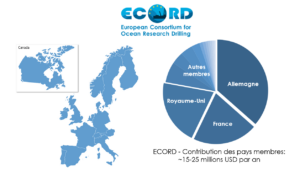
Since 2003, the European Consortium for Ocean Research Drilling (ECORD, https://www.ecord.org/) has contributed to these programs. ECORD is a consortium of 15 partners (14 European countries – Austria, Denmark, Finland, France, Germany, Ireland, Italy, the Netherlands, Norway, Portugal, Spain, Sweden, Switzerland, and the United Kingdom – as well as Canada). This consortium and other international partners fund and participate in the IODP (Integrated Ocean Drilling Program 2003-2013; International Ocean Discovery Program 2013-2024, https://www.iodp.org/) et IODP³ (International Ocean Drilling Programme depuis 2025, https://iodp3.org/).

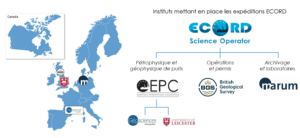
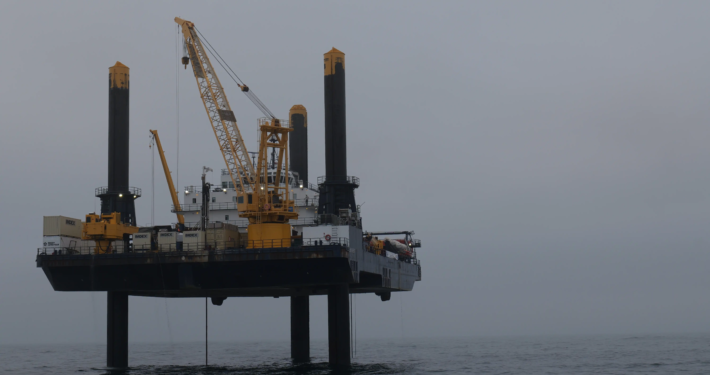
Part of the Drilling Measurement and Experimentation team is part of the European Petrophysics Consortium (EPC). EPC provides the personnel, equipment, and expertise necessary for collecting petrophysical data from core samples and geophysical data from wells. With our partners (British Geological Survey and Marum), we form the ECORD Science Operator (ESO) and contribute to the organization of offshore expeditions and data acquisition. In this context, CEEL tools were deployed to collect data during the following expeditions:
Continental Scientific Drilling
Données
Data Data from the IODP-IODP³ programs are available on the Lamont-Dehorty Earth Observatory LogDB, website by searching for the shipment number.
Data from the ICDP OODP are available here.
ICDP DFDP data are available upon request via the project website.
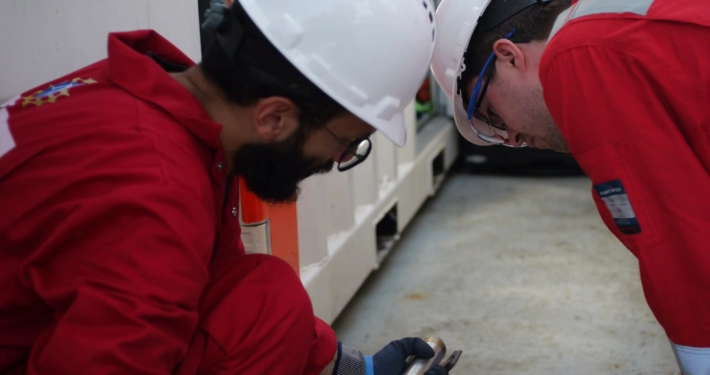
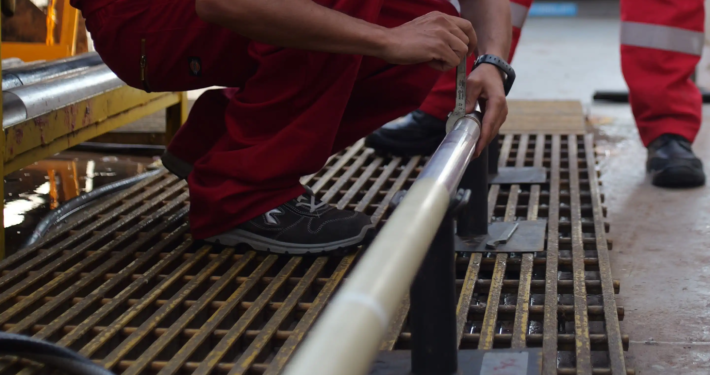
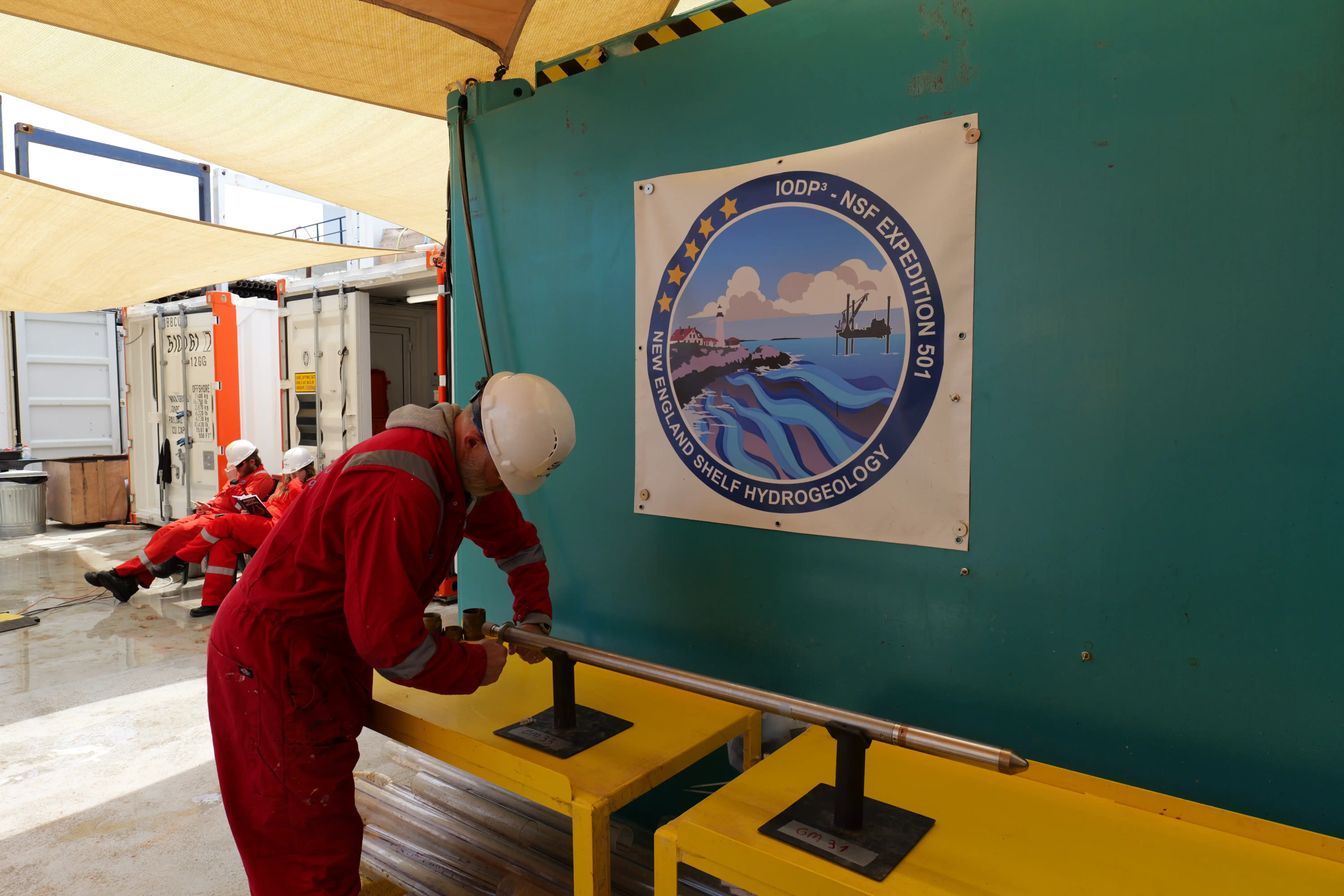
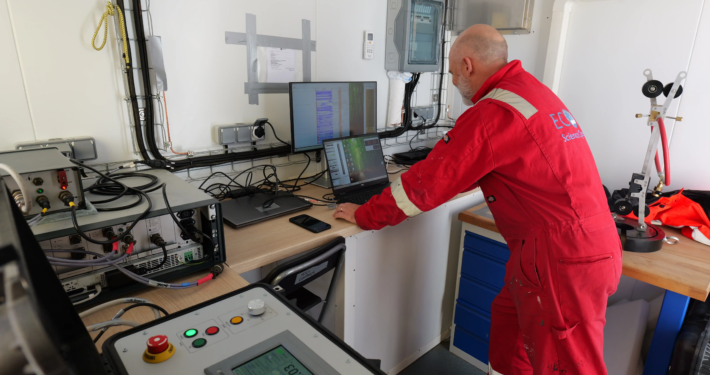
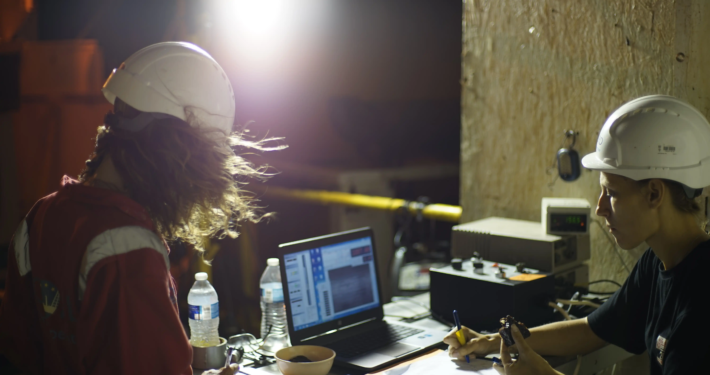
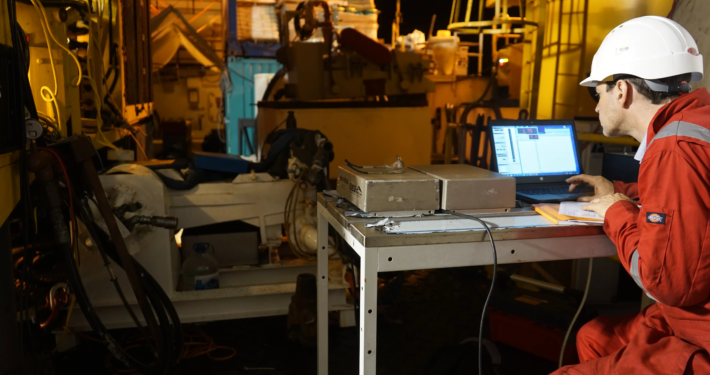
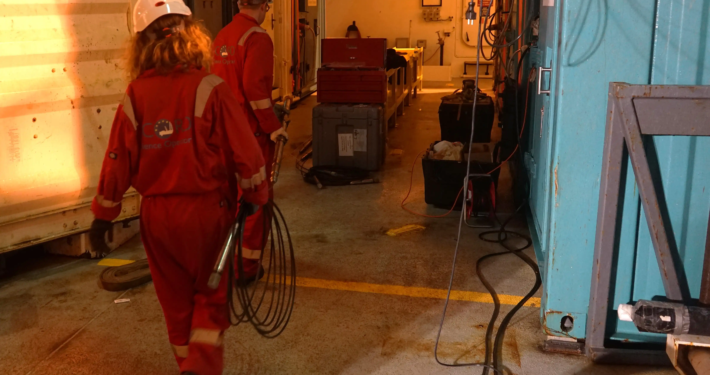
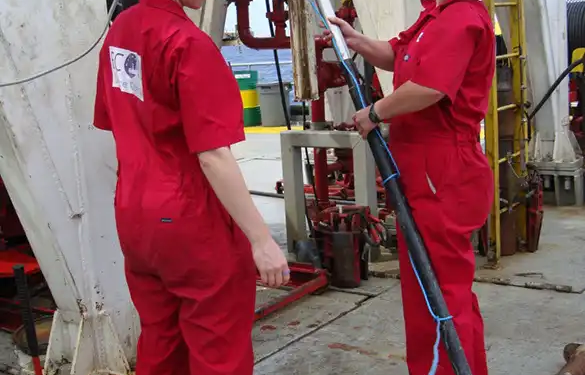
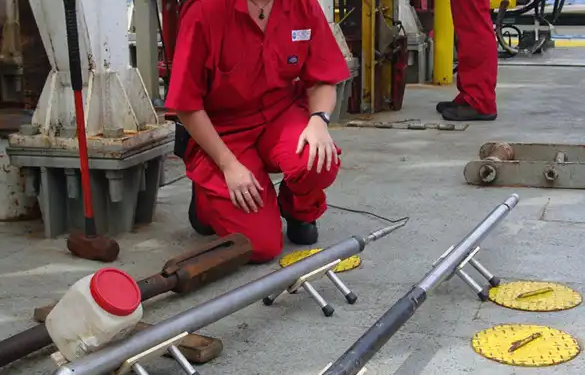
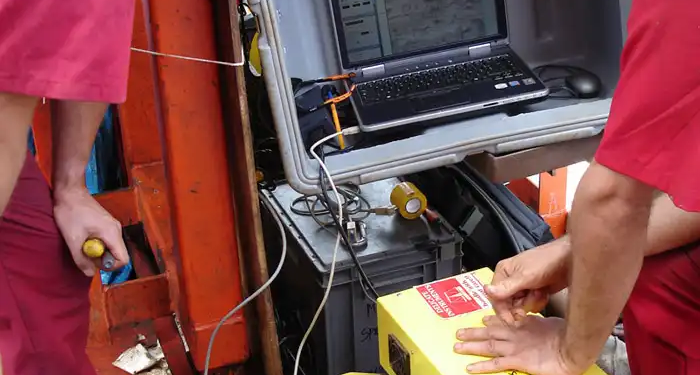
Several study and observation sites are monitored by the TMP team as part of national and international programs. Some of the geophysical and borehole hydrodynamic data acquired using CEEL tools within these programs contributes to the databases of two observatories:
CEEL tools are used to characterize and/or monitor different sites:
| Site | Thème | Lithology | Labeling | Publications/reports | Project | |
| Maguelone | Hérault, France | Aquifers, saltwater intrusions, CO2 | Silicoclastic | OREME | Lofi et al. 2013, Pezard et al. 2016 | ALIANCE, MUSTANG |
| Roussillon | Pyrénées-Orientales, France | Aquifers, saltwater intrusions | Silicoclastic | OREME | Petelet-Giraud et al. 2016, Caballero et al. 2022, Pezard et al. 2022 | Gain d’Sel, Dem’Eaux, AQUIMER |
| Thau | Hérault, France | Aquifers, saltwater intrusions | Carbonate, karst | Ladouche et al. 2023, Widhen et al. 2023 | Dem’Eaux | |
| Ploëmer | Morbihan, France | Aquifers, saltwater intrusions | Granite | OREME / H+ | Belghoul et al. 2010 | ALIANCE |
| Argentona | Spain | Aquifers, saltwater intrusions | Silicoclastic | OREME | Palacios et al. 2020, Martínez-Pérez et al. 2022 | |
| Campos | Spain | Aquifers, saltwater intrusions | Carbonate, karst | OREME / H+ | Van Meir et al. 2006, Pezard et al. 2009, Hebert et al. 2011, Garing et al. 2013 | ALIANCE |
| Svelvik | Norway | CO2 | Silicoclastic | OREME / | Denchik et al. 2014 | CO2 FieldLab |
| Lodève | Hérault | gravity instabilities | ? | Denchik et al. 2018 | ||
| Larzac | Aveyron | Aquifers | Carbonate, karst | OREME / H+ | ||
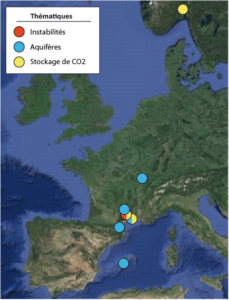
Localisation des sites instrumentés par Géosciences Montpellier et actuellement rattachés à l’OSU-OREME. Des données de géophysique et hydrologue en forage sont régulièrement acquises sur ces sites. La plupart d’entre eux sont également équipés d’observatoires permanents du sous-sol.
Scientific manager :
Johanna LOFI
E-mail : johanna.lofi [at] umontpellier.fr
Technical manager :
Gilles HENRY
E-mail : gilles.henry [at] umontpellier.fr
Philippe PEZARD
E-mail : philippe.pezard [at] umontpellier.fr
Philippe GOUZE
E-mail : philippe.gouze [at] umontpellier.fr
Laurent BRUN
E-mail : laurent.brun [at] umontpellier.fr
Muriel GEERAERT
E-mail : muriel.geeraert [at] umontpellier.fr
Gérard LODS
E-mail : gerard.lods [at] umontpellier.fr
Fadl RAAD
E-mail : fadl.raad [at] umontpellier.fr
Erwan LE BER
Courriel : erwan.le-ber [at] umontpellier.fr
Simon BARRY
Courriel : simon.barry [at] umontpellier.fr
Building 22
Campus Triolet
Address :
GEOSCIENCES MONTPELLIER
Université de Montpellier – CC 60
Place Eugène Bataillon
34095 MONTPELLIER Cedex 5
FRANCE
Vehicles access :
475 Rue du Truel
34090 MONTPELLIER
Géosciences Montpellier
Université de Montpellier
Campus triolet cc060
Place eugène bataillon
34095 montpellier cedex05
FRANCE
Where to find us