
[Conférence GM & ED Gaïa]
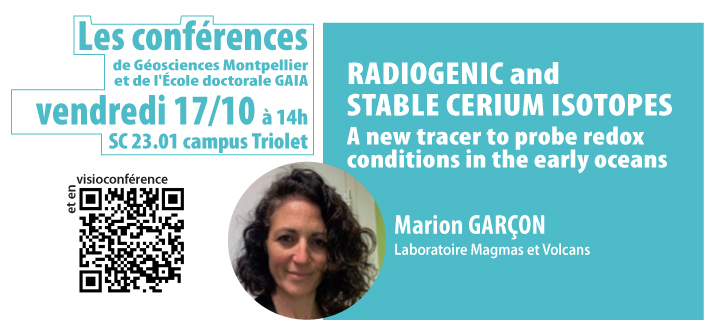
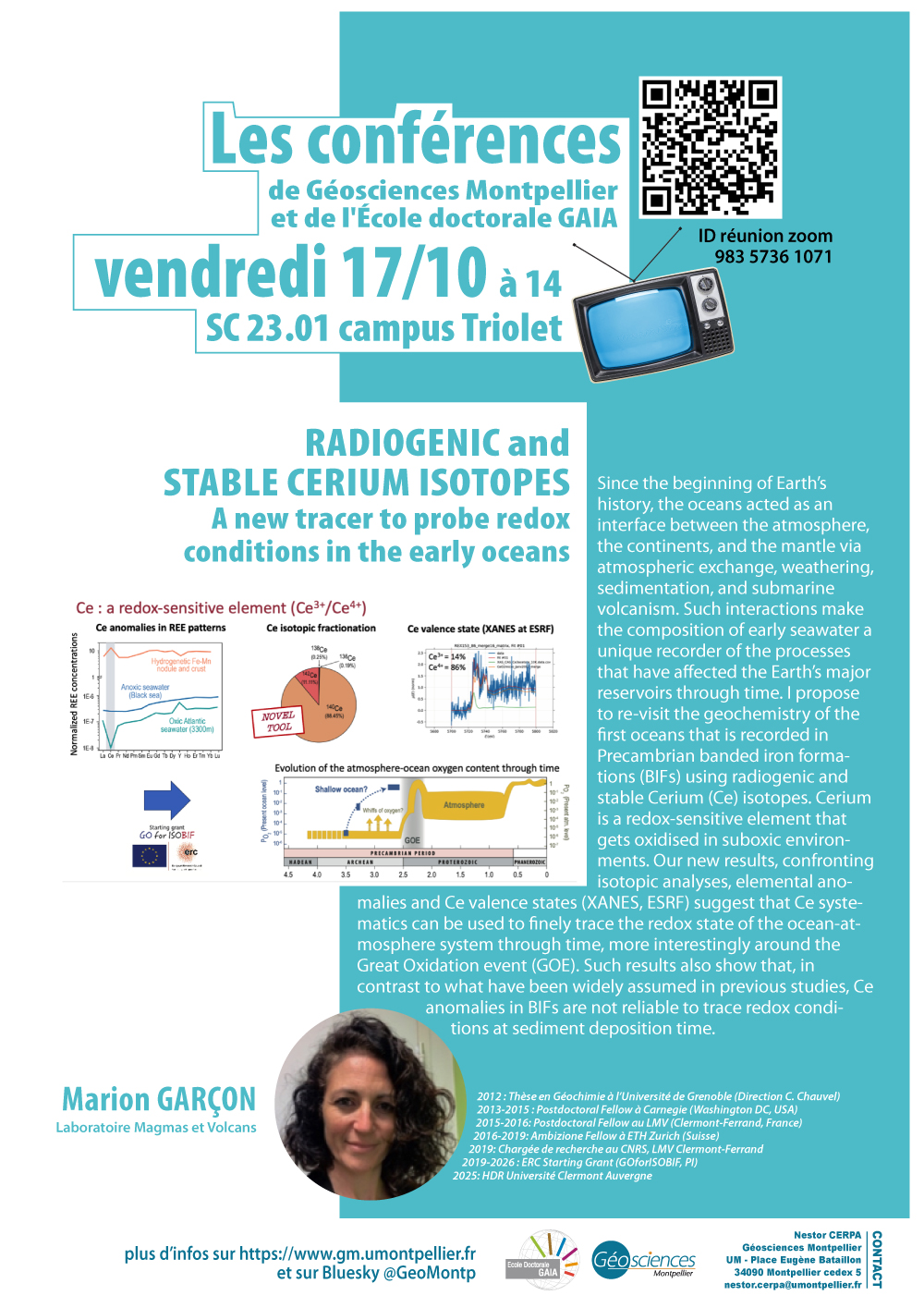
Radiogenic and stable Cerium (Ce) isotopes: A new tracer to probe redox conditions in the early oceans
Par Marion GARCON (Laboratoire Magma et Volcan)
14:00 amphi 23.01, campus Triolet, Université de Montpellier
Participer à la conférence (ID : 983 5736 1071)
Since the beginning of Earth’s history, the oceans acted as an interface between the atmosphere, the continents, and the mantle via atmospheric exchange, weathering, sedimentation, and submarine volcanism. Such interactions make the composition of early seawater a unique recorder of the processes that have affected the Earth’s major reservoirs through time. I propose to re-visit the geochemistry of the first oceans that is recorded in Precambrian banded iron formations (BIFs) using radiogenic and stable Cerium (Ce) isotopes. Cerium is a redox-sensitive element that gets oxidised in suboxic environments. Our new results, confronting isotopic analyses, elemental anomalies and Ce valence states (XANES, ESRF) suggest that Ce systematics can be used to finely trace the redox state of the ocean-atmosphere system through time, more interestingly around the Great Oxidation event (GOE). Such results also show that, in contrast to what have been widely assumed in previous studies, Ce anomalies in BIFs are not reliable to trace redox conditions at sediment deposition time.
- 2012 : Thèse en Géochimie à l’Université de Grenoble (Direction C. Chauvel)
- 2013-2015 : Postdoctoral Fellow à Carnegie (Washington DC, USA)
- 2015-2016: Postdoctoral Fellow au LMV (Clermont-Ferrand, France)
- 2016-2019: Ambizione Fellow à ETH Zurich (Suisse)
- 2019: Chargée de recherche au CNRS, LMV Clermont-Ferrand
- 2019-2026 : ERC Starting Grant (GOforISOBIF, PI)
- 2025: HDR Université Clermont Auvergne
Radiogenic and stable Cerium (Ce) isotopes: A new tracer to probe redox conditions in the early oceans
